
 United Kingdom · Autumn 1872
Part of: Around the world in eighty days · 18 of 28
18 · San Francisco · 3 – 5 Dec
San Francisco, a political meeting

Trip details
- When
- 2 Oct – 21 Dec 1872
- How long
- 81 days
- Who went
- Me, Passepartout, and from Pillaji, Aouda
- Stops
- 28
- Getting around
- 40,000 km by steamer, rail, elephant and sledge
In this story · 2 chapters
We came alongside the wharf at San Francisco at seven o'clock on the morning of Tuesday 3 December. The train for New York left at six in the evening. I had eleven hours in a city I had not seen, which is more time than I usually allow myself for anything, and I intended to spend it usefully.
A carriage took us to the International Hotel, a large and handsome building on Montgomery Street where the dining room serves breakfast at all hours without asking for it to be ordered. Oysters, beef, eggs, bread, coffee, and a pale wine from the valleys north of the city that I thought quite tolerable. Mrs Aouda ate with appetite after nineteen days of ship's provisions. Passepartout ate with something more than appetite.
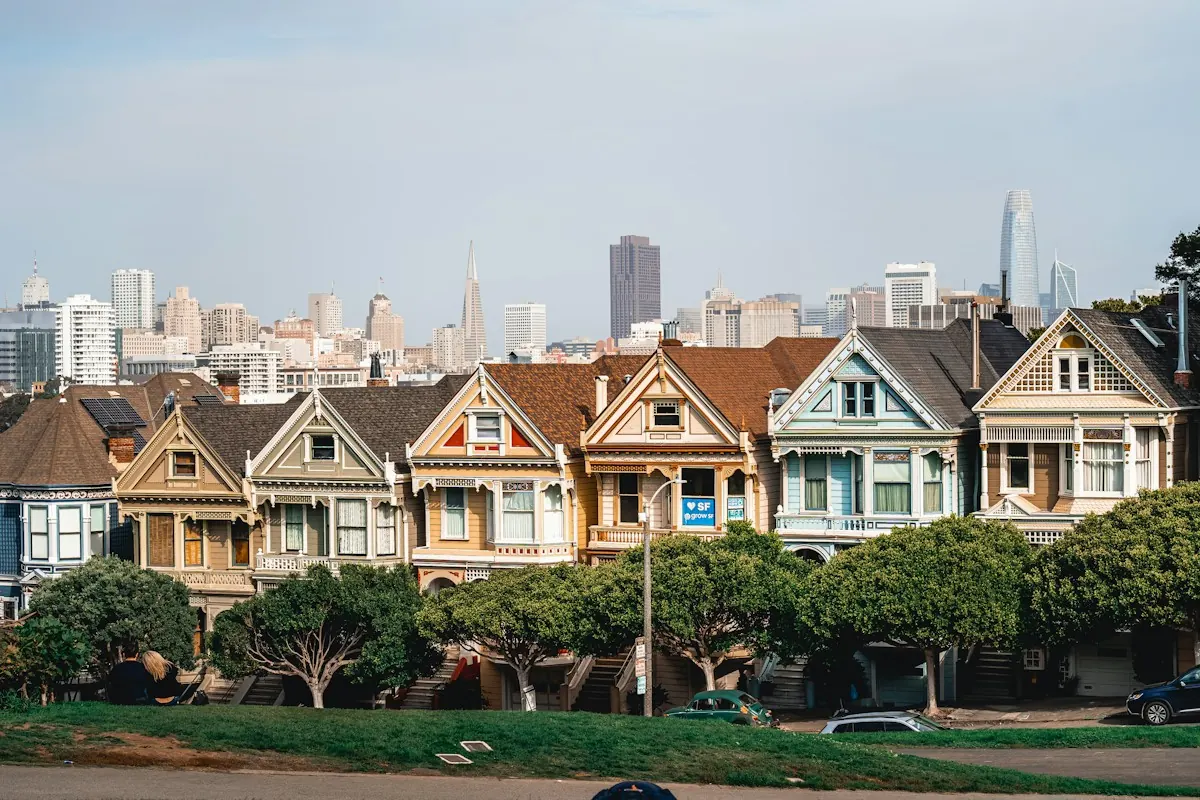
The city is built on hills so steep that the streets go up them at angles that would be thought unreasonable in London. The houses are mostly of wood, painted in a great many colours, and the people are of every nation on earth, all in a hurry. I found it agreeable, though I could not have lived there. Nobody walked slowly enough to be overtaken.
01 Provisions for the railway
After breakfast I went to the British consulate to have my passport stamped, as I had at every stop, so that nobody in London could doubt my route. Then I attended to equipment. I had been told, at the hotel and again at the consulate, that the railway across the continent passed through country where the trains were sometimes stopped and attacked, and that passengers did well to go armed. I do not care for firearms, as a rule, but I do care for being prepared.
I sent Passepartout to a gunsmith's on Kearny Street with instructions to buy a dozen Enfield rifles and the same number of Colt revolvers, with ammunition. He came back with the receipt and an expression of mild alarm. He asked whether we were expecting a war. I said that I expected nothing; I merely intended not to be surprised. He went off muttering that in that case he hoped I would not want a cannon as well.
A dozen of each is perhaps more than four people need. I reasoned that our fellow passengers might be glad of them, and so it proved, though not until Wyoming.
02 The meeting
At about one o'clock, walking back along Montgomery Street with Mr Fix, who had attached himself to us again in the street with an air of pleased coincidence, I found the way blocked by a crowd of several hundred people. There were banners, and placards on poles, and men standing on the steps of a building making speeches nobody could hear. It was, Fix explained, a political meeting. Some public office was to be filled, a justice of the peace I think, and the two candidates were called Camerfield and Mandiboy. Their supporters had come to settle the matter in person.
I had no opinion on the question, and said so. I wished only to cross the street. This proved impossible. The crowd heaved one way and then the other, the placards began to be used for purposes other than display, and in a very few minutes the meeting had become a general fight. Fists, sticks, boots. A hat went past my head at speed. Mrs Aouda, thank heaven, was safe at the hotel.
I found myself, without having moved, face to face with a very large man with a red beard and a red face, who demanded to know which side I was on. I told him I was on neither. He seemed to take this as the worst answer possible. He gave his name, unasked, as Colonel Stamp W. Proctor, and called me something unflattering about the English, and swung at me.
He did not hit me. Mr Fix stepped between us and took the blow himself, full on the top of his hat, which was flattened, and with it very nearly Mr Fix. I have since reflected on that moment a good deal. At the time I had no idea who Fix was or what he wanted of me. I knew him only as an amiable fellow passenger who seemed always to be going my way. I did see his face as he straightened up, and he looked as astonished as I was. I do not think he had decided to do it. I think he simply found that he had.
I told Colonel Proctor that he was a Yankee and that I would have his name, which I already had, and his address, which he gave me. He said that any time I wished for satisfaction he would be pleased to provide it. I said that I would return to America to obtain it as soon as my present engagements allowed. He seemed surprised that I meant it. I did.
I had no opinion on the question, and said so. I wished only to cross the street.
We got out of the crowd by a side street, with our coats torn and Fix's hat beyond repair. I took him to a tailor's and outfitted us both afresh before dinner. He protested. I insisted. It seemed the least I owed a man who had taken a punch intended for me, whatever his reasons, and I find I still do not know entirely what they were.
We dined at the hotel at half past four. Passepartout, who had been told the story by Fix in a version that I suspect improved in the telling, looked at the detective with something close to approval for the first time since Hong Kong. It did not last.

At a quarter to six we were at the Oakland ferry, and at six exactly the train for the East pulled out with us aboard, the rifles in the luggage van and the Colonel's address in my pocket book. Balance: none in hand. Three thousand seven hundred and eighty-six miles to New York.
Photos from San Francisco