
 United Kingdom · Autumn 1872
Part of: Around the world in eighty days · 19 of 28
19 · Salt Lake City · 5 – 7 Dec
A sermon in the sleeping car

Trip details
- When
- 2 Oct – 21 Dec 1872
- How long
- 81 days
- Who went
- Me, Passepartout, and from Pillaji, Aouda
- Stops
- 28
- Getting around
- 40,000 km by steamer, rail, elephant and sledge
The Pacific Railroad carriages are long saloons with an aisle down the middle and seats on either side that turn into berths at night, so that the whole train becomes a dormitory on wheels. It is an ingenious arrangement and an entirely public one. Mrs Aouda had a curtained berth. I slept well. Passepartout claimed not to have slept at all, and was found snoring at six.
01 The herd
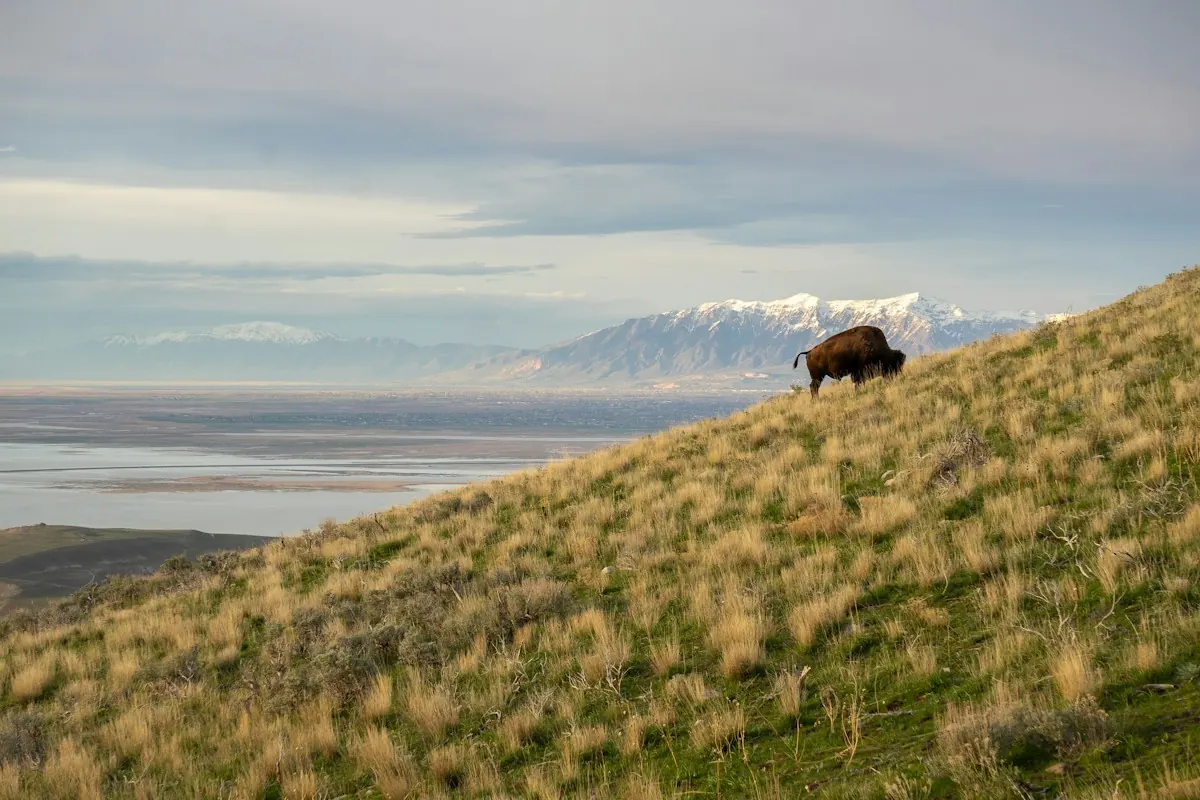
On the afternoon of Wednesday 4 December, somewhere in the high plains of Nevada, the train slowed, and stopped, and stayed stopped. I looked out. Across the line, from one side of the valley to the other, a herd of bison was crossing. Ten or twelve thousand of them, the conductor thought. They walked at a steady, unhurried pace, heads down, in no particular order, and there was no end to them.
The driver did not try to push through. He was right not to. A train going into a herd of that weight would have been derailed in the first fifty yards. The only thing to do was wait, and so we waited, three hours by my watch, from ten past two until a quarter past five, while the bison went by.
Passepartout found this intolerable. He walked up and down the carriage. He went out onto the platform and stared at the herd as if he could hurry it by the force of his opinion. He proposed, in order, that the driver should blow the whistle, that the passengers should all go out and shout, and that somebody should fetch one of the rifles. He said that in France the animals would have been taught to respect the timetable.
I told him that the bison had been crossing this valley for a very long time before the railway arrived, and would probably go on crossing it after it was gone, and that in their view we were the ones holding them up. I then returned to my game. I was playing with Mr Fix and Mrs Aouda and a gentleman from Chicago, and the hand was an interesting one. Three hours lost; but I had allowed for the possibility of three hours lost somewhere between San Francisco and New York, and it might as well be here.
In their view, we were the ones holding them up.
02 The Elder
The next morning, Thursday 5 December, the train stopped at Ogden, the junction for Salt Lake City, with some hours in hand before it went on. A number of passengers took the branch line down to the city to see it. I went with Mrs Aouda. It is laid out in perfect squares, with wide streets and water running in channels at the sides, and behind it the mountains, white already, standing over a great flat lake that does not look like water at all until the light catches it.

Passepartout stayed on the train, and so it was he and not I who attended the lecture. I set down what he told me.
A man had come aboard at Ogden, tall, grave, dressed in black, and had gone through the carriages announcing that he would speak in car number 117 at eleven o'clock on the subject of the Latter-day Saints. His name was Elder William Hitch. He was a missionary of that church, going home to it after some years spent preaching in the eastern states. About thirty passengers went to hear him. Passepartout went because, he said, he had never met a Mormon and wanted to know whether they were like other people.
They are, it seems, very like other people. The Elder spoke for about an hour, plainly and earnestly, about the founding of his church, the persecution of its first members in Missouri and Illinois, the death of Joseph Smith at the hands of a mob, and the long journey west across the plains to this valley, with handcarts, in winter, by people who had been driven out of every place they tried to live. Passepartout said it was a sad story and that the Elder told it as a man tells the history of his own family, which, for him, I suppose it was.
The audience was less patient than the speaker. They had come for the question everybody asks about the Mormons, which concerns their marriages, and when the Elder spoke instead about crops and irrigation and the building of the city, they began to drift away by twos and threes. By the end of the hour only one listener remained. The Elder looked at him and asked whether he, at least, had faith. Passepartout said that he had faith in his master, and was a Catholic besides, and had one wife's worth of trouble already without the means of supporting her. The Elder laughed. Passepartout says he had a good laugh. They shook hands.
I asked him afterwards what he made of it all. He said he did not agree with a word of it, but he would have liked the man for a neighbour. I could not have put it better and did not try.
We left Ogden at six in the evening. Balance: three hours behind my own allowance, none in hand overall. Next, the Wasatch, and the Rocky Mountains, and a bridge.
Between Ogden and Salt Lake City
Photos from Salt Lake City