
 United Kingdom · Autumn 1872
Part of: Around the world in eighty days · 25 of 28
25 · Atlantic Ocean · 12 – 20 Dec
How to buy a ship and burn it

Trip details
- When
- 2 Oct – 21 Dec 1872
- How long
- 81 days
- Who went
- Me, Passepartout, and from Pillaji, Aouda
- Stops
- 28
- Getting around
- 40,000 km by steamer, rail, elephant and sledge
In this story · 3 chapters
The master of the Henrietta was Captain Andrew Speedy of New York, a man made of the same material as his hull. He was about fifty, with red hair, a red face, a voice that had been shouted into a gale for thirty years and seen no reason to lower itself since, and no fondness for passengers. I found him on his own deck, and asked him whether he would take four of us to Liverpool.
He said he was going to Bordeaux. I said I would pay him to go to Liverpool. He said he was going to Bordeaux. I offered him a sum that would have bought a good deal of Bordeaux. He said he did not take passengers, he did not like passengers, he had never liked them, and if he ever did take any it would not be to Liverpool, because he was going to Bordeaux. He then turned his back on me to shout at a man who was doing nothing wrong.
I asked him whether he would take us to Bordeaux, then. He looked at me for a while, decided that I was mad and therefore probably rich, and said that he would, at two thousand dollars a head. I agreed at once. We sailed at nine that evening, 12 December.
01 A change of command
Captain Speedy did not know, when we cast off, that I had spent the afternoon in conversation with his crew. They were good seamen and, it turned out, not especially devoted to their captain, whose temper they had endured since New York last saw them. I explained my position. I said that I needed to be in Liverpool and not Bordeaux, and that I was prepared to pay well for the difference. By the time the pilot left us that night, the crew and both mates were with me. The engineer came over for a sum which I shall not record, out of respect for his privacy and my own.
On the morning of the 13th Captain Speedy found that he was locked in his own cabin. I was told that the noise he made was audible in the engine room over the engines. Passepartout, who took him his meals, said that it was like feeding a thunderstorm through a keyhole. I took the bridge. I am not a seaman by profession, but I have spent a good deal of my life reading about ships and a good deal of the last ten weeks watching them handled, and I had a first-class crew who wanted to be paid. At noon on the 13th the Henrietta came about and set her course for Liverpool.
Mrs Aouda watched all this with what I can only call alarm. Mr Fix watched it with something worse: I believe it was the first time on the journey that he had seen me do something he could describe in a court of law. He was certainly looking at me as a man looks at a fact. Passepartout, for his part, was in a state of joy. He said he had always wanted to serve a pirate and had never expected his master to make the change so late in life.
02 Storm and coal
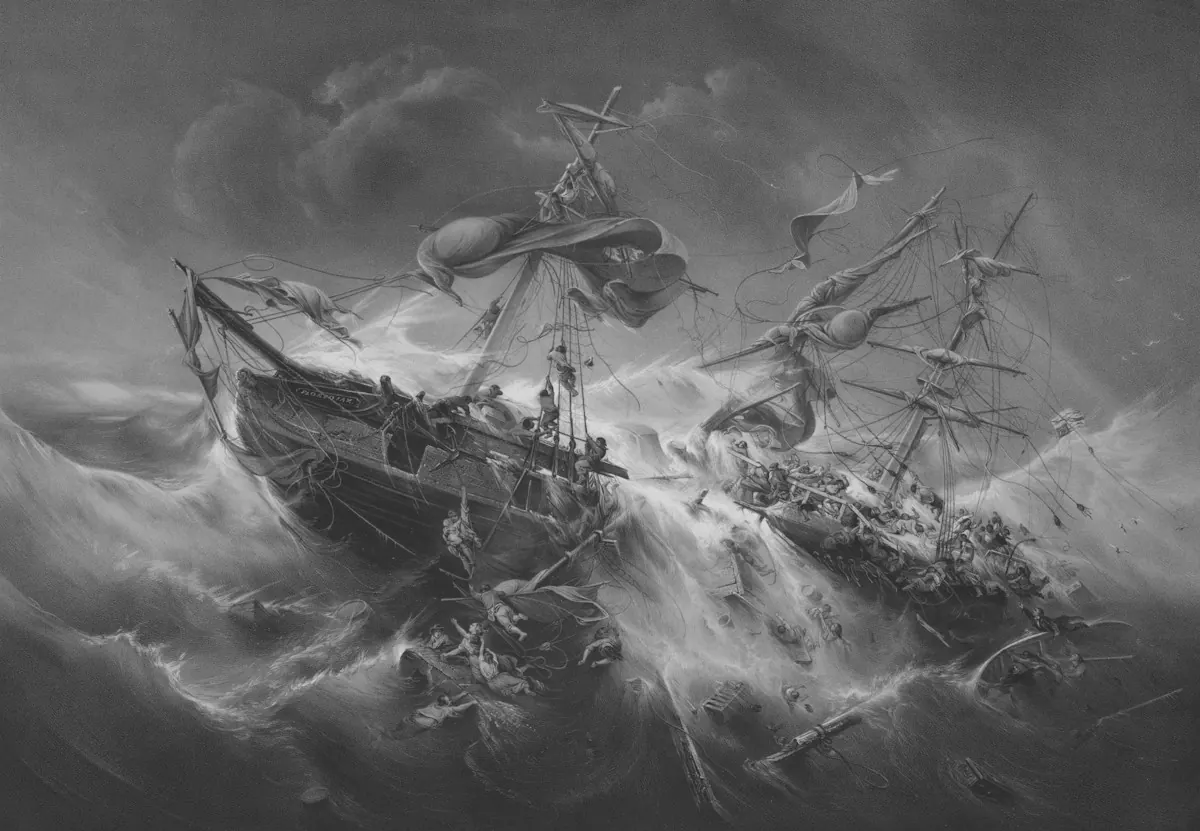
For the first few days the weather was fair and the ship went well under both steam and sail. On the 16th the wind went round to the south-east and rose to a gale, and the sea with it. I furled the sails, kept her head to the sea and drove her on under steam alone. She was a fine ship. She rose to the seas as if she had an opinion about them, and she came through without serious damage, though we lost some speed.
Passepartout spent the gale between the galley and Captain Speedy's door, carrying soup to the one and apologies to the other, and getting neither accepted. Mrs Aouda stayed on deck longer than I liked, holding to a stanchion and watching the seas come at us. When I asked her to go below she said that she had been in a typhoon on a pilot boat a month before and saw no reason why the Atlantic should be treated with more respect than the China Sea. I could not fault the logic. I sent Passepartout up with a coat instead. Mr Fix was ill for two days and said nothing about warrants.
It was on that same day, the 16th, that the engineer came up to tell me what I had begun to suspect. Captain Speedy had taken on coal for Bordeaux, at an economical speed. We were making for Liverpool, a longer way, at full speed. There was not enough coal to reach it. At the present rate the bunkers would be empty on the 18th.
I told him to keep the fires up to full pressure until the last shovelful. He looked at me, and then went below and did it. There is a kind of order that a man obeys because he cannot think of anything better himself, and I find that it is generally the most reliable kind.

03 Sixty thousand dollars
On the 18th, at about noon, the engineer reported that the coal would last until evening and no longer. I sent Passepartout to fetch Captain Speedy from his cabin. He came on deck like a shell leaving a gun, saw me, and demanded to know where we were. I told him we were seven hundred and seventy miles from Liverpool, and that I wished to buy his ship.
He was so astonished that for the first time in our acquaintance he stopped speaking. I explained that I needed fuel, that the only fuel aboard was the ship herself, and that I would sooner burn my own property than his. I asked him what she was worth. He said, after a pause that I could hear him using to reckon, that she was worth sixty thousand dollars, which was a good deal more than she was worth. I paid him sixty thousand dollars in notes from my bag, there on the bridge. I then pointed out that I meant to burn only what would burn: the hull and the engines would remain, and I had no further use for them once we were in port, so they would be his again, free of charge, on arrival.
I watched him think about this. A ship worth, perhaps, forty thousand dollars, sold for sixty, and the iron part of her, which was the valuable part, handed back to him at the end. His face went through several colours, all of them red. Then he took the money and put it in his pocket and said, with real feeling, that I was a Yankee. I understood this to be the highest compliment available to him, and I accepted it in that spirit.
| Date | Burnt | Notes |
|---|---|---|
| 18 Dec, evening | Cabins, bunks, saloon furniture, spare spars | Coal exhausted at about 7 pm. Captain Speedy watched his saloon go into the furnace without comment. |
| 19 Dec | Masts, yards, rafts, deckhouses, the poop | Axes all day. Sails no longer needed; no masts to set them on. |
| 20 Dec | Bulwarks, deck planking, the remaining upper works | By evening she was an iron hull with a funnel. Queenstown lights sighted at night. |
| Total | Everything that would burn above the waterline | Price paid: $60,000. Hull and engines returned to Captain Speedy. |
We burnt her from the top down. The crew went at it with axes and saws and a kind of furious cheerfulness, and the stokers fed what they were given into the furnaces, and the pressure held. The first evening it was the cabins and their furniture: the mahogany and the bunks and the panelling. Mrs Aouda's own cabin went in with the rest, and she helped carry the drawers. The next day the masts came down, and the spars and rafts after them; then the deckhouses and the high deck at the stern. On the 20th they took up the decking and cut away the bulwarks.
Captain Speedy watched all of this. At first he walked about muttering over each piece as it went below, as a man might watch his house being sold room by room. Then, by degrees, his manner changed. On the second day I found him standing beside me at the wheel. He said nothing for some time, and then he said that he had been at sea for thirty years and had never seen a ship driven like it. On the third day he offered me advice about the trim, which was good, and which I took.
A ship is only the thing that holds the engine up. I had paid for the engine to keep going.
On the evening of the 20th we raised the light at Fastnet, and later the lights of Queenstown. The Henrietta was by then a bare iron shell with a funnel in the middle of it, smoking like a chimney on an empty lot, and she was still making eleven knots. I have never been more pleased with anything that looked so little like a ship.
When we came to the harbour I put the bridge back into Captain Speedy's hands. He shook mine for a long time and asked whether I would consider going to sea professionally. I said that I would consider it if he would consider giving up shouting. Neither of us, I think, meant to take the matter further.
Balance: one day and some hours in hand, by the calendar in my notebook. Liverpool to come, then London.
Read nextFour days on a pilot boatThe other time I paid a captain handsomely to sail somewhere he had not planned to.
Aboard the Henrietta
Photos from Atlantic Ocean