
 United Kingdom · Autumn 1872
Part of: Around the world in eighty days · 22 of 28
22 · Omaha · 9 – 10 Dec
A sledge with a sail

Trip details
- When
- 2 Oct – 21 Dec 1872
- How long
- 81 days
- Who went
- Me, Passepartout, and from Pillaji, Aouda
- Stops
- 28
- Getting around
- 40,000 km by steamer, rail, elephant and sledge
In this story · 2 chapters
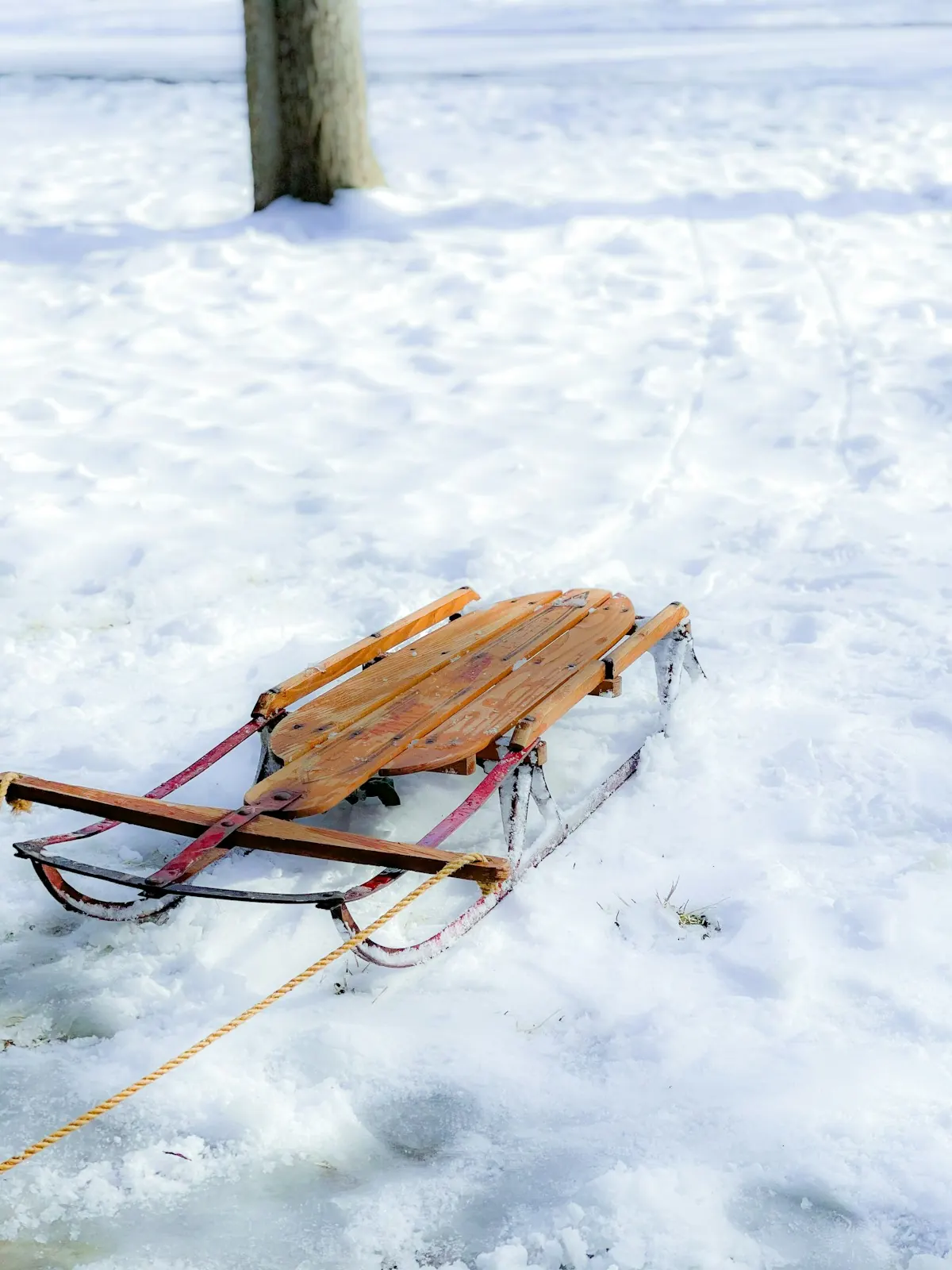
Mr Fix's man with a sledge was called Mudge. He had built the thing himself: a long, flat frame on two runners, room for five or six people, with a mast amidships and a large sail, and a sort of rudder at the stern for steering. In winter, when the snow lies on the prairie and freezes hard, he carried passengers between the stations when the trains were stopped. He said it went as fast as an express in a good wind. I asked him whether there was a good wind. He held up a wet finger, looked at the sky with professional contempt, and said there was a west wind and it would get stronger.
I asked him the price to Omaha. He named it. I did not argue, which surprised him more than the journey did. We left at eight in the morning, Mudge at the helm, Passepartout at the bow, Mr Fix and I on either side, and Mrs Aouda in the middle, wrapped in every fur and travelling rug that the fort and the sledge between them could supply.
The distance from Fort Kearney to Omaha is about two hundred miles. Mudge reckoned on doing it in five or six hours if the wind held. It held. Once the sail was hoisted and the sledge was moving, it seemed hardly to touch the snow at all. The runners hissed. The prairie went past on both sides without a tree or a house to measure it by, so that the only sign of our speed was the wind in our faces, which was considerable, and Mudge's satisfaction, which was more so.
The cold was very great. The wind that drove us was the same wind that went through our coats, and at that speed it had a cutting quality I had not met even in the Channel in February. Mrs Aouda never once complained. When I asked her, at intervals, whether she was warm enough, she said she was, which was untrue, and asked me whether I was, which was also untrue. We each pretended to believe the other. It seemed the most practical arrangement.
Passepartout, at the bow, sat with his face red and streaming and an expression of pure happiness, having been a prisoner twenty-four hours before. He shouted things to Mudge that the wind took away. Once he began to sing, and stopped only because his teeth were chattering too hard to keep time.
Mr Fix sat beside me and looked straight ahead. I do not know what he was thinking. I can guess. He had followed me from Suez in the belief that I was a thief. He had tried in Bombay, in Calcutta and in Hong Kong to have me stopped, and each time I had gone on. Now we were back on British-made paper, as it were: in a few days I should be on English soil, where his warrant would at last mean something, and he could arrest me there. It was in his interest to hurry me home. I believe he had suggested the sledge partly for that reason and partly for a reason he did not care to examine. He wished me to reach England. He did not wish me to fail. I think this troubled him.
01 Company
Towards noon we saw wolves. There was a pack of them running some way off to the north, keeping pace with us for a mile or two, grey shapes against the white. Mudge did not alter course. Passepartout loaded a revolver and held it in his lap with the air of a man who would rather not be asked to use it. The wolves came no closer. I believe they had concluded, correctly, that anything moving at our speed was either not worth eating or not possible to catch. After a while they fell behind and turned away, and I made a note of the time they had been with us: about twenty minutes.
We crossed frozen rivers without noticing them, except for a slight change in the note of the runners. We passed a few lonely farms, roofs heaped with snow, and once a line of telegraph poles that ran beside us for some miles and then wandered off on business of its own. There was no sound but the wind and the runners. I have rarely been anywhere so quiet that was going so fast.
At one o'clock Mudge pointed ahead and said we were nearly in. The roofs and smoke of Omaha appeared over the snow. We had come about two hundred miles in five hours. I paid Mudge his fare and a sum besides for the sail, which I said had done more for me than several steamships, and he shook my hand as if he meant to keep it.
02 Chicago and on
At Omaha a train was just leaving for Chicago, and we caught it without ceremony. We crossed Iowa through the afternoon and night, by Council Bluffs and Des Moines and Iowa City, crossed the Mississippi at Davenport and came into Chicago on the evening of 10 December. Chicago is a city that is in the middle of being rebuilt, having burnt down the year before last, and it has the busy, impatient look of a man dressing in a hurry. We were there only long enough to change trains.
The train for New York left at once. It ran through Indiana, Ohio, Pennsylvania and New Jersey, a long, comfortable, monotonous run, and Passepartout slept through most of it. Mrs Aouda read. Mr Fix watched the country. I played no whist, there being no fourth, and worked out what I had won back. The sledge had made up most of the time lost at Fort Kearney. The steamer China for Liverpool was due to sail from New York at nine o'clock on the evening of the 11th.
Balance: perhaps nothing in hand, perhaps a little behind. The train will decide.
Fort Kearney to Omaha, by sledge
Photos from Omaha